Wood transport
Do you need a reliable carrier for domestic or international timber transport? By choosing experience, you can rest assured about delivery timeliness. Contact us — benefit from the knowledge of top specialists and get professional transport!
Transport of wood and wooden components — how do we transport them?
There are several methods of transporting wood:
1. Trucks with trailers:
♦ Standard trailers: Used for transporting pallets with boards, wood-based panels, or beams. These trailers can be equipped with tarpaulins to protect the wood from weather conditions.
♦ Stake trailers: Designed for transporting long logs, i.e., long pieces of round wood, often used for direct transport from forests.

2. Low-bed trailers and car carriers:
♦ Low-bed trailers: Used for transporting large wooden components such as beams, joists, and large boards. These allow for easy loading and unloading using cranes (HDS) or forklifts.
♦ Car carriers: Specialized vehicles used to transport round wood or large construction components.
♦ Standard containers: Used in international transport, especially sea freight. Wood is stacked and secured inside the container to protect it from weather and facilitate transshipment.
♦ Open Top containers: Allow for transporting wood that exceeds standard container dimensions.
Wood transport using HDS vehicles
We also use professional HDS cranes for transport services, enabling quick and safe loading and unloading of wood, regardless of type or size. This is especially effective in hard-to-reach locations or construction sites where traditional loading methods fall short.
Transport with HDS requires special attention and strict compliance with applicable regulations. The key aspect is the mass of the cargo — wood, especially in long logs or trunks, can be very heavy, requiring legal compliance.
To ensure complete safety during transport and loading/unloading, proper cargo securing must be applied, in accordance with road regulations and industry standards. We use certified straps, chains, and securing systems to keep the wood stable even in difficult road conditions.
The most common type of wood transport — palletized loading
 Pallet loading is the most commonly used wood transport method, especially for sawn timber — i.e., wood cut into boards, beams, battens, or slats. Since the material is pre-cut and standardized in length and thickness, it can be efficiently palletized and grouped into cargo units. This significantly speeds up loading/unloading, simplifies storage, and makes better use of cargo space.
Although it may seem easier than long log transport, this method also requires proper qualifications, experience, and equipment. Correct weight distribution on the trailer and secure fastening of pallets are crucial. We use strong transport straps, tensioners, and, if needed — steel wires or nets to prevent wood from shifting.
The most difficult type — long log transport
Long log transport, i.e., transporting whole felled trees, is the most demanding type of wood transport, both logistically and technically. It involves non-standard dimensions — often exceeding several meters in length, requiring specialized vehicles and additional safety measures.
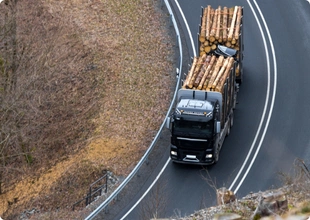
Long log transport is handled with extended road sets designed for oversized loads. These vehicles feature steel support frames, or stakes, that hold tree trunks firmly in place. Due to their size and weight, routes must account for height/width restrictions, entry bans for oversized vehicles, and road conditions. This often requires prior arrangements and permits.
Firewood — transport, any quantity and weight
Firewood is used as fuel for heating and cooking. It’s one of the oldest and most traditional energy sources, used in household fireplaces, stoves, and larger heating systems. It comes from various tree species, both deciduous and coniferous.
To transport firewood, the carrier should use only vehicles and equipment suitable for this material. iCaro’s fleet includes:
♦ trucks with 13.6m standard trailers (including MEGA),
♦ tarpaulins,
♦ low-bed trailers (platforms, tiefbett, semi),
♦ 7.7+7.7 truck sets,
♦ curtain-side trailers,
♦ tippers,
♦ car carriers,
♦ and more.
We are equipped with all the professional tools necessary for safe and efficient loading, including hydraulic lifts, forklifts, hoists, and other specialized devices. Why is loading so important in this case? Because wood is considered a “living” material. This means that improper securing during transport may cause it to shift in transit, potentially leading to damage.
Transport of Wooden Components
The most commonly transported wooden elements include a wide range of products used in construction, furniture making, and interior finishing. The most popular are:
♦ Boards – used in building structures, floors, walls, and as decorative elements. Boards can be cut to various lengths and thicknesses depending on the project.

♦ Beams – mainly used in window and door frames and in building frameworks. Known for their strength and precision manufacturing.
♦ Wood-based panels – such as plywood, particleboard, and MDF, widely used in furniture production, interior finishing, and construction. Appreciated for strength, workability, and versatility.
♦ Joists and girders – key structural components used in houses, bridges, roofs, and other large constructions. Made of solid or laminated wood for added strength.
♦ Wall and floor panels – such as paneling, laminated panels, or parquet, used for interior finishes, offering both aesthetic appeal and insulation.
♦ Moldings and profiles – used to finish edges, corners, and joints, both inside and outside. Available in various styles, from simple to decorative.
♦ Laminated timber – layered wood elements used in furniture, building joinery, and architectural structures. Known for dimensional stability and durability.
Transporting these wooden components requires proper securing and strategic stacking to ensure they arrive undamaged and ready for further processing or installation.
What to Know About Wooden Cargo Transport
Transporting wooden components requires careful planning and proper securing to prevent damage and preserve material quality. Items such as boards, beams, or panels should be placed on pallets or in specially designed containers for load stability. It’s essential to use fastening straps to prevent shifting during transit. Additionally, the cargo should be protected from moisture and weather exposure using protective foil or tarpaulins. On longer routes, monitoring vehicle interior conditions like humidity and temperature is crucial to avoid wood warping or mold. By following these rules, your wooden materials will arrive safe, intact, and ready to use.
Wood and Timber Transport – Let Us Handle It!
Wood transport is often considered difficult – and when poorly handled, it can result in serious penalties. At iCaro, we know how to handle wood transport properly and legally. Leave the formalities and compliance to our trusted specialists. We guarantee that your goods will be delivered on time and according to plan.
We can also perform urgent transport services efficiently and punctually. In some cases, we can begin execution just hours after you submit your request. Reach out today — tell us your cargo details and get a free quote quickly. You’ll be assigned a dedicated specialist who will oversee the process from A to Z.